

Do I Have to Be Famous to Write a Memoir?

When I tell people I’m a ghostwriter and I help others tell their stories, I almost always hear one of two things.

The first is: “I’ve always wanted to write a book.”

The second is: “I have an interesting story, but no one would want to read it. I’m not famous.”

Let’s start with the first group.

Get Over Your Excuses and Write the Book

If you’ve always wanted to write a book, my answer is simple…

You should.

Your story doesn’t need permission. It doesn’t need a platform or a blue checkmark. This isn’t high school and you’re waiting to be assigned a topic to write on. The only thing standing between you and the page is what you’ve placed in front of it.

We all have the same 24 hours. The difference is how we use them. If time feels like the barrier, take an honest look at how many minutes slip away to scrolling, streaming, or busywork that doesn’t matter.

You don’t need long, uninterrupted days to write a book. You need consistency. A few minutes at a time is enough. Books are written the same way anything meaningful is built: one small, deliberate step after another.

And if the fear isn’t time but talent, you’re in good company. Even authors who had amazing success with their first books often face crippling imposter syndrome and worry the second book won’t be a success. (If you find that to be the case, there’s always a Vice Presidential run.)

Many people know what they want to say but don’t know how to shape it into something others want to read. That’s where support comes in. Some people outline with AI. Others dictate their thoughts. Some choose to work with a professional. Hiring a ghostwriter isn’t for everyone, but it exists for a reason: to help translate lived experience into a clear, compelling story.

Now to the second group—the ones who believe their story doesn’t matter because they’re not famous.

That simply isn’t true.

The Connection Behind Commonality

If anything, our culture has moved in the opposite direction. Social media, influencers, podcasts, reality television—we are more interested than ever in other people’s lives. Years ago, The Truman Show felt like an absurd concept (at least to me). Who would want to watch someone else’s ordinary life? Now we do it daily.

People read memoirs for connection. For recognition. To see themselves reflected in someone else’s choices, mistakes, resilience, or growth.

If you’re considering a memoir, ask yourself this instead:

Have you learned something that could help someone else?

Maybe it’s how to survive a season you didn’t choose or how to leave an abusive relationship.

Perhaps it’s how to build a life, a business, or a sense of self from the ground up.

Memoir isn’t about fame. It’s about meaning.

And while most of us understand that writing a book won’t make us billionaires, books do something far more lasting. They help people feel less alone. They create understanding. Research consistently shows that readers develop deeper empathy. Like most readers will tell you, when you spend 200 or 300 pages inside someone else’s experience, your perspective shifts.

That matters.

So when someone tells me they want to work with me to write a book, I don’t ask if they’re famous. I ask what they’ve lived, what they’ve learned, and why it matters now.

And if your story keeps tugging at you—if it’s been sitting quietly (or not so quietly) in the background of your life—stop ignoring it.

Stop wondering whether your story is “enough” and start exploring how to tell it well.

I work with people who don’t want noise. They want clarity. Together, we shape lived experience into a story that has impact and purpose.

Your story doesn’t need fame.

It needs care.

If you’re ready to give it that, I’m here.
A Reason You Might Not Have Thought of to Tell Your Story

Change is hard—even the change you want.

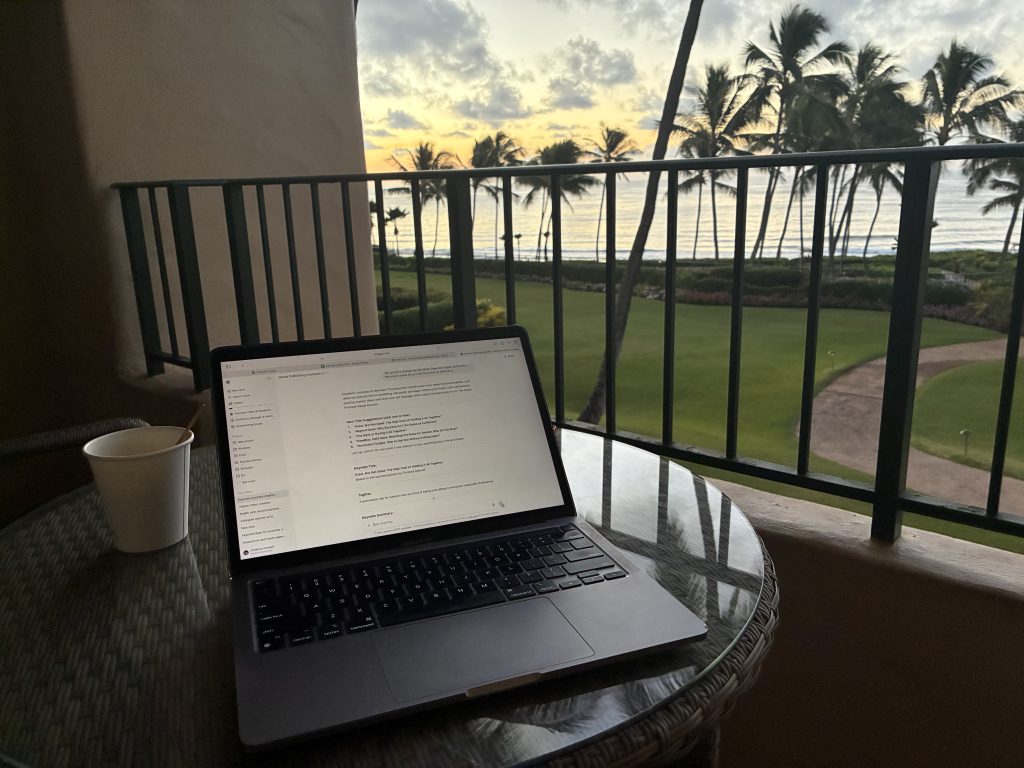
On our last day of Thanksgiving vacation, my computer died. I grabbed my phone and Googled solutions. Panicked. The black screen of death mocked me. I closed the laptop and stared at the ocean.

I was filled with dread.

There I was on a balcony in balmy weather and I should’ve been enjoying my last day at the beach. Instead, my thoughts were on everything I might’ve lost.

Years ago I made the decision to switch to cloud storage. While it’s my usual course of action to save to the cloud, I couldn’t help but think there might be something that perished on the hard drive.

Pictures. Notes. Things I couldn’t get back.

No dip in the pool or rainbow-colored cocktail could cure my unease. It was like the bitter aftertaste left in your mouth after swallowing cough syrup from the ’70s.

I couldn’t shake it.

My husband recognized this and went about solving the problem—ordering me a new laptop and having it delivered in two days, once we’d be home.

I was relieved he had taken care of it because I was in the type of mood that is not conducive to good decision making.

We made it home from vacation and a few hours before my new laptop was to be delivered, my old one rebooted. No more black screen. It’s like it told me it needed a rest and now it was ready to tackle the workday.

I spent several hours on it catching up on work. We were back together like Cagney and Lacey. But my husband reminded me my new computer was on its way and we could no longer trust this one. I wanted to cover its ears. After all, it had been my faithful companion for three years and visited multiple states and countries with me.

I was used to how its keys felt under my fingertips. I knew the weight of it in my bag.

But my husband was right. It had shut down with no advanced warning, no overheating, no overworking—just a slow workday morning out on the balcony facing the beach, not too hot, not too cold. And it refused to do as I asked.

As a writer, my laptop is one of the only things I need to do my job. I can even muddle through without an internet connection. But at 53, I find writing on a phone exhausting. I have an iPad, but it does weird things on some apps. My laptop is my ride or die and it had chosen to die.

When my new laptop arrived, I set it up. It wasn’t the same weight or the same size. The keyboard felt different. It didn’t feel like a Mac at all. It was clunky, like the early Dells. But my ride or die had shown me it was unreliable so my hand was forced, or so I told myself. Yet, I lingered over my old laptop.

I told my husband I would slowly transition to the new one. He reminded me my transition better move along because Apple was expecting my old laptop back as part of our trade-in deal.

Ugh. Change.

I couldn’t have the best of both worlds, keeping my unreliable but fancier laptop until it chose not to start again.

But will this new laptop perform like the early days of my previous laptop? Will it have all of my same apps and logins saved? How will this new one work with AI? Will it be faster like the marketers claimed, or will it shut down inexplicably like my other one?

I knew I had to change but I didn’t want to. Why couldn’t I keep things the way they were? I wanted to stick with what I knew, even though I also realize this change is for the best.

Perhaps you’ve made a change recently—even a small one—where you know it’s the right thing to do but you don’t want to.

If you have, you’re doing something that others have thought about as well. Even in the seemingly silly example of changing out a dead computer, someone somewhere has agonized over that decision.

Changing up your hair. Going for the promotion. Walking out on an unfaithful lover even though you appear to have the “perfect life.”

Change is a necessary part of growth, large or small. It’s that point in time hovering at the crossroads where you can go forward into something unknown or you can cling to what you do know that’s not working.

Even if you’re averse to change, you’ve been through it. Maybe you lost a parent, spouse, or child. Maybe you gave up something that was harming you physically or mentally.

You weathered change and you’re stronger for it.

Or it knocked you down like a rogue wave, scraped you up pretty badly, made you eat sand. But you learned from it.

Sharing your story of change (and how you lived through it) is a powerful way to give back. It helps someone know they’re not alone, and it teaches what you’ve learned—either as a lesson in how to survive or what not to do.

All good stories start with wanting something that is out of reach, and you can’t get what you want without change. It may bend you or break you, but if there’s something you want, you’ll have to change in order to get it.

Sharing how you did that is a story people will want to read, no matter how common the desire.

After all, you just finished this blog post, didn’t you?


If you’re ready to share your change story, contact me and we’ll talk.