Most people think ghostwriting is ‘just writing.’ It’s not. There’s a lot of work done shaping the story, deciding what makes it in and what doesn’t, and translating memories into life lessons that everyone will understand and relate to no matter what their experience.
It’s tricky. I’m part confidante, part grammarian, part impersonator (I want the book to sound like you), part story strategist, part producer, part project manager, and part guide (after all, I have to make sure we don’t get lost in the process.)
That’s why sometimes I have to give my clients some tough love so that our work together is the best it can be. If you’re considering writing a book, whether you do it with me, AI, your assistant, or on your own, here are a few hard things I tell everyone.
Tough Love Advice When Writing a Book
Some stories will be left out. A strong book is selective. More detail usually dilutes the message.
If you tell your truth, some people angry may be angry. Real life involves real people, and they may not agree with your version.
A good book makes people feel things—and you might not like what they feel. Reaction is part of impact and you can’t control other’s reactions. The goal isn’t universal approval. It’s resonance.
You don’t have to tell everything. Privacy is part of craft. If a detail doesn’t serve the message, you can protect it.
This process can be emotionally demanding. Even business books ask you to make meaning out of experience. That takes energy.
What This Looks Like When We Work Together
My job isn’t just to write clean sentences. It’s to help you shape the story, choose what belongs (and axe what doesn’t), and build a book that’s tight, coherent, and true to your voice.
While each project is vastly different, my professional goal for each is the same. I want my clients to hear the phrase, “I thought about your book long after I finished it.” That’s the mark of a story told well.
If you’re considering a book and want a strategic partner in the process, reach out. Use my contact form and tell me what you’re trying to say, who it’s for, and where you’re stuck. I’ll reply with next steps and let you know if I’m the right fit.
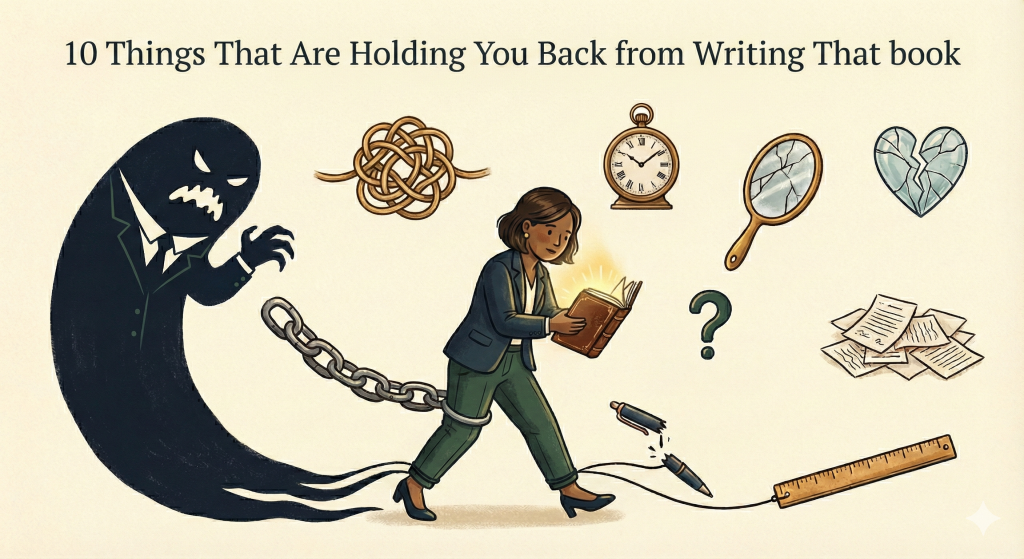
Everyone tells you that you should write a book. But something’s holding you back. Let’s walk through the ten most common reasons you’re not on shelves yet. And it’s not talent.
Do you hear it?
For some people, the phrase shows up like clockwork.
At conferences.
At dinner parties.
When having wine with friends.
“You should write a book.”
If you’ve heard it more than once, there’s a reason. People don’t hand out that sentence casually. It’s usually because they see something in you — wisdom, perspective, survival, humor, or leadership — that deserves a permanent home on the page.
But if something’s been nudging you to write… and something else has been stopping you… you’re not alone.
I’ve even been there and I’m a professional.
Here are the 10 most common roadblocks I see when working with leaders, founders, and survivors who’ve carried a book inside them for years.
1. You Think Your Story Isn’t “big enough.”
It’s rarely about the size of the events. It’s about the meaning behind them.
Impact comes from honesty, not spectacle. You don’t have to have experienced something extraordinary. Your coping or leadership in ordinary circumstances can still inspire. After all, there are more of us grappling with common struggles than the blockbuster “astroid hitting the earth” scenarios.
2. You Don’t Know Where to Start.
Beginnings feel intimidating because most people confuse “start writing” with “start perfectly.”
Books begin in conversation, curiosity, and messy notes — not chapter one. When I made the switch from fiction to non-fiction with my book The Glinda Principle, I kept notes for months–little ideas I jotted down, not sure where I was going. I just knew I had something to say. Maybe a book, maybe an essay.
After a few weeks, I couldn’t believe how many thoughts had percolated into my notebook. The book practically wrote itself at the point.
But what it didn’t’t do was edit itself. (This is where you’ll spend most of your time so don’t worry about where to start. Just start.)
3. You’re Afraid of Being Misunderstood.
Sharing your story isn’t just an act of communication; it’s an act of courage.
You want control over the message, and that’s valid.
Plus, once you put it in writing, it feels permanent. This makes a lot of people step back and wonder what they’re saying and who they’re saying it about.
This is your truth. Write it first. Worry about those details afterward. Same goes for the next one…
4. You’re Worried About Hurting Someone.
Memoirs and leadership books often touch relationships, conflict, and truth.
There are ways to tell the story with integrity and kindness. You can also create amalgams of characters so no one person feels wronged by the portrayal.
But again, tell your story first, the concern about liable and feelings can come later during editing.
5. You Don’t Think You’re a Writer.
Well, you’re not…yet.
And you don’t have to be. Writing is a craft, but storytelling is human instinct.
If you speak in a truthful way that helps connect people to your experiences and how it relates to their own, you’re already a quarter of the way there. We just have to “capture it” at that point.
It feels like learning an entirely new language before you even know what you want to say. But worrying about that before you’ve ever written a word is like being concerned about how you’ll transport a cake to an upcoming event when you don’t even have an oven to bake it in.
7. You’ve Tried Before… and Stalled.
Half-written drafts are not failures. They’re proof you cared enough to start.
Screenshot
A stalled draft usually means you didn’t have a structure — not that you didn’t have a story.
And, maybe, just maybe it wasn’t the right time for the world to hear your message.
8. You Don’t Know Who Your Reader Is.
This is the one I give my clients the hardest time about. We all want to believe our stories are for everyone.
But they’re not. At least not initially.
There is someone who wants (and needs) to hear your. Who is that person? How old are they? What’s their background? Where do they hang out online and in-person? When you can figure those things out, you can write with that person in mind.
Once you do that, it’s impossible not to finish because you don’t want to let that person down.
Clarity about your audience also sets everything up including voice, shape, pacing, purpose.
9. You’re Scared Your Experience Will Be Judged.
Anyone who has lived deeply carries stories with sharp edges.
The goal isn’t to impress — it’s to resonate. Readers connect to truth, not polish. Perfectionism has killed more writing careers than the pen (or keyboard) of a spiteful critic.
Plus, you’re not for everyone.
In fact, there are people who hate chocolate. And although they are wrong and very ill, they are entitled to their opinion.
If chocolate can’t make everyone happy, neither can you and that’s okay.
10. You Don’t Have the Time.
Here’s the part most people don’t realize:
Many of the world’s most meaningful books were not written by the person whose name is on the cover.
They were shaped, structured, and carried to completion with a ghostwriter or–at the very least–a capable editor.
Most of us don’t have a year to carve out to learn the publishing industry, and become a full-time writer. I wrote one of my books for an hour a day in my car on my lunch hour.
You can chip away at the goal of becoming an author the same way I did in stolen moments around a full-time job and a family or you can partner who a ghostwriter who can help you turn experience into narrative and narrative into impact full-time. The first way (doing it part-time on your own) might take a year or longer depending on your schedule.
Do you want your story to wait that long? Do you want your audience to?
Just because you don’t have the time doesn’t mean the world doesn’t need your message.
If you’re one of the many people who keep hearing “You should write a book” and feel a quiet yes beneath the fear and logistics — let’s talk.
Sometimes the first step isn’t writing. It’s a conversation.
Hiring a ghostwriter is a little like inviting someone into your mental attic. They’ll sort through memories, ideas, and half-finished chapters of your life or business…and they’ll be there for months. If you want the project to succeed, you will be getting very vulnerable with them. (Yes, even if you’re writing a business book because you’re going to have to show the world what you went through to get where you are now.)
The right partner makes that experience energizing. The wrong one makes it feel like an alien abduction.
If you’re looking for a ghostwriter, here’s how to choose someone who will bring out your best story and make the process enjoyable.
1. Look for someone you genuinely enjoy talking to
You’re going to spend hours in conversation with this person. Real, vulnerable, story-heavy conversations. You want someone who listens well, asks questions that make you think, and feels like a partner you’d willingly grab coffee with. Chemistry isn’t an optional extra. It drives the entire creative process.
Plain talk: if you wouldn’t want to tell them about the moment your life changed, they probably shouldn’t be the one writing your book.
2. Don’t rely too heavily on portfolios
Seeing someone’s published work can be helpful, but it’s rarely the full picture. Most ghostwriters don’t own the copyright to what they create, and many aren’t credited. In some cases, the pieces they show you may not even represent their strongest work or their true range. Every ghostwriter is confined by the client’s story and voice.
Instead, look for signals you can trust: testimonials, client experiences, referrals, and how clearly they explain their process. And if you know someone who’s worked with a ghostwriter? Ask them everything. Word-of-mouth is a strong endorsement.
3. Make sure they understand your field — at least at a basic level
You’re the expert, but if your ghostwriter has zero context for your industry or the ideas you’re trying to express, you’ll end up doing a lot of heavy lifting. Not because they’re incapable — because you’ll constantly need to translate. A writer who already understands the landscape can make your life easier and your message sharper. They’ll also know the right questions to ask.
A ghostwriter who understands your industry or background will have a better grasp of your ideal audience too. That’s incredibly important because not only are they telling your story or expressing your knowledge as a thought leader, they’re writing to that audience. If they don’t know who that audience is, the pivotal connection of what makes your story resonate with them will be lost.
You shouldn’t have to spoon-feed every concept. A shared foundation makes the storytelling smoother.
Real talk: “everyone” is not your ideal audience. If the ghostwriter thinks “everyone” is a good fit for your book, they obviously don’t know who your audience is. Even Taylor Swift isn’t for everyone.
4. Ask about their process and make sure it fits how you want to work
Ghostwriting is not a one-size-fits-all experience. Some writers do long-form interviews. Some collaborate in documents. Some disappear for three months and return with a manuscript. Knowing how they work tells you everything about what the next several months will feel like.
A good process creates clarity, momentum, and trust. If their structure energizes you, that’s your sign.
5. Pay attention to how they talk about story — not just writing
Great ghostwriters don’t fixate on word count. They focus on why your story matters, what it could become, and how to shape it so readers feel something. If a writer talks about story in a way that clicks with you, that’s a strong indicator they’ll handle yours with care.
Look for someone who can translate your ideas into meaning, not just chapters.
6. Notice how they listen
This one’s subtle, but it might be the most important. Do they interrupt? Do they jump straight into solutions? Or do they give you space to tell the story in your own way first? Ghostwriting is built on trust, and trust is built on the quality of the listening.
A good ghostwriter is part writer, part editor, part marketer and story strategist, part journalist, part translator, and part problem solver. They have many hats to wear but the main thing you want to feel after that first call or meeting is understood.
Choosing a ghostwriter isn’t about finding the person with the longest résumé. It’s about finding the person who can help you unlock the story you’ve been carrying, someone who can turn your lived experience into something lasting.
If you choose well, the book becomes more than a project. It becomes a partnership.
If something in this piece nudged you — a memory, an idea, a story you’ve been carrying — let’s talk. Every book partnership begins with a simple conversation.
Every story I help tell starts with intention. When people say they want to “write a book,” they don’t actually mean physically. Few of us like sitting at a keyboard, striking keys until the tips of our fingers are numb.
What most people want is to have written a book. They want the legacy, the clout, or the pride of having something in writing that talks to who they are.
My clients come to me because they have something worth preserving, teaching, or passing on. Often people in their lives have told them they need to write a book to share their experiences.
But most people don’t know how to start or how to finish.
They fall in love with the idea, but can’t complete the action.
They need an assistant to do the heavy lifting. That’s what I do.
I work with two kinds of people and often, they overlap.
1. The Teachers: Leaders, Coaches, and Speakers
These are the professionals who turn ideas into action for others. They’ve built frameworks, delivered keynotes, and led teams, but now they want to expand that influence beyond the room.
Together, we translate lived experience into clear, credible thought leadership. The kind that builds authority and connection. Their books and essays become extensions of their voice — strategic tools that open doors to new audiences, opportunities, and impact.
2. The Legacy Builders: People with Extraordinary Stories
Some of my clients aren’t building a business, they’re preserving a life. Survivors, founders, caregivers, and changemakers who’ve lived through something worth documenting. They’re writing for meaning, not metrics.
These stories don’t just tell what happened; they reveal why it matters. Whether it’s a memoir, a reflection on resilience, or a generational story, these projects capture truth in a way that helps others and honors what it took to get here.
We Might Be a Great Team If…
You’ve thought, “Someone needs to write this down — before I forget.”
You’re as interested in the message as the medium.
You value process, reflection, and high standards.
You want a writing partner who listens deeply and writes strategically.
You’re ready to turn experience into something lasting — a book, a message, a legacy.
The right story, told well, can outlast everything else you build.
Most people have a story worth telling. Few have the time—or the emotional distance—to tell it well.
Maybe you have a coaching or speaking business and you need to distill your brilliance into a commodity you can sell.
That’s where a ghostwriter comes in.
Working with a professional ghostwriter isn’t about handing off your story. It’s about collaboration. A good ghostwriter listens for what you mean as much as what you say.
They translate lived experience into clear, compelling language that readers—and publishers—can connect with.
For leaders and entrepreneurs, a ghostwriter can help shape ideas into a book that builds credibility and legacy. For survivors and storytellers, it’s a way to turn memory into meaning without getting lost in the emotions or structure.
You’re not outsourcing your voice. You’re partnering with someone who can amplify it—so your message lands exactly as you intended.
Because a well-told story doesn’t just share what happened. It shows who you are—and why it matters.
A ghostwriter is part interviewer, part editor, part translator, part jigsaw puzzle assembler, and part marketer.
A professional ghostwriter takes what’s in you and brings it out in words that sound like you on your best day in a way that appeals to your ideal audience.
That means shaping raw stories, recorded conversations, or notes into a clear, structured manuscript that feels effortless to read. Much like putting together a puzzle, an expert ghostwriter looks at everything and puts the pieces together in a way that is interesting and meets your goals.
Delivery Is Everything
If you’ve ever watched a comedian, you know how important delivery is. It’s not always what they say but how they say it.
The same goes for a ghostwriter.
You have lots of great stories and information but how those are told and arranged makes a difference between something that sells and something that sits.
The best ghostwriting feels invisible.
Readers hear your voice, not the writer’s. The structure is seamless, the emotion is intact, and the message lands exactly as you intended.
Behind every “overnight success” book, there’s often someone quietly doing this work—helping ideas find their true form on the page.
Very few celebrities write their own books. It’s not worth their time and that’s not where their expertise lies.
What about you?
Is it worth your time to write your story or can you trust a professional to handle it?
Think about your personal and professional lives. What things do you entrust to others because they know more about it and have the time to do it? Your lawn, the care of your children, your personal hygiene?
Some clients love to be part of every brainstorm and review. Others prefer to share their story in a few deep conversations and then let the writing unfold.
A good ghostwriting partnership adapts to your style. You stay the author and the heart of the story.
Your writer handles the structure, flow, and polish that make it publishable.
You’ll see your fingerprints on every page but without developing callus on your writing finger.
Ghostwriting is the ideal solution for anyone who wants to tell their story or impart their wisdom but doesn’t have the time to dedicate to the story’s gestational period and its labor.