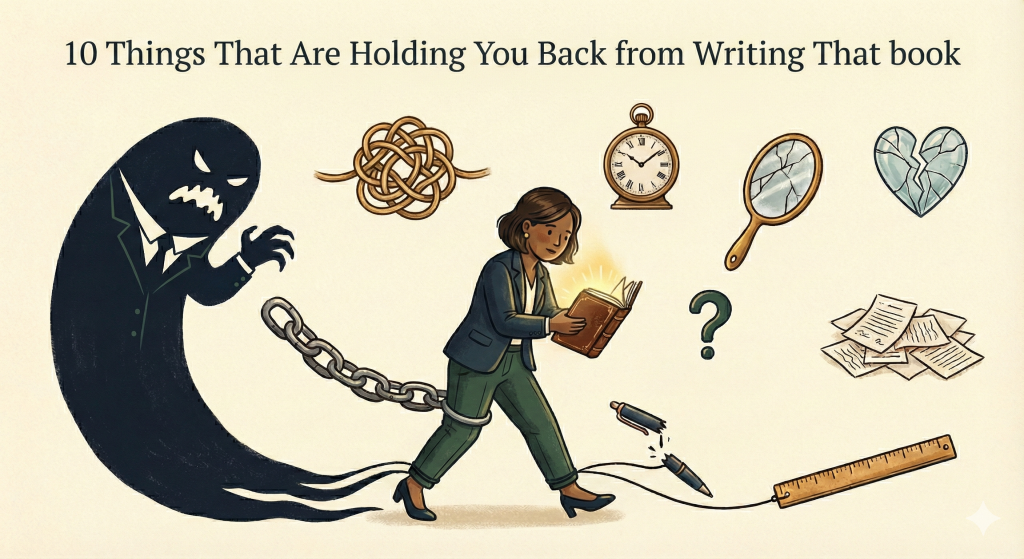
Everyone tells you that you should write a book. But something’s holding you back. Let’s walk through the ten most common reasons you’re not on shelves yet. And it’s not talent.
Do you hear it?
For some people, the phrase shows up like clockwork.
At conferences.
At dinner parties.
When having wine with friends.
“You should write a book.”
If you’ve heard it more than once, there’s a reason. People don’t hand out that sentence casually. It’s usually because they see something in you — wisdom, perspective, survival, humor, or leadership — that deserves a permanent home on the page.
But if something’s been nudging you to write… and something else has been stopping you… you’re not alone.
I’ve even been there and I’m a professional.
Here are the 10 most common roadblocks I see when working with leaders, founders, and survivors who’ve carried a book inside them for years.
1. You Think Your Story Isn’t “big enough.”
It’s rarely about the size of the events. It’s about the meaning behind them.
Impact comes from honesty, not spectacle. You don’t have to have experienced something extraordinary. Your coping or leadership in ordinary circumstances can still inspire. After all, there are more of us grappling with common struggles than the blockbuster “astroid hitting the earth” scenarios.
2. You Don’t Know Where to Start.
Beginnings feel intimidating because most people confuse “start writing” with “start perfectly.”
Books begin in conversation, curiosity, and messy notes — not chapter one. When I made the switch from fiction to non-fiction with my book The Glinda Principle, I kept notes for months–little ideas I jotted down, not sure where I was going. I just knew I had something to say. Maybe a book, maybe an essay.
After a few weeks, I couldn’t believe how many thoughts had percolated into my notebook. The book practically wrote itself at the point.
But what it didn’t’t do was edit itself. (This is where you’ll spend most of your time so don’t worry about where to start. Just start.)
3. You’re Afraid of Being Misunderstood.
Sharing your story isn’t just an act of communication; it’s an act of courage.
You want control over the message, and that’s valid.
Plus, once you put it in writing, it feels permanent. This makes a lot of people step back and wonder what they’re saying and who they’re saying it about.
This is your truth. Write it first. Worry about those details afterward. Same goes for the next one…
4. You’re Worried About Hurting Someone.
Memoirs and leadership books often touch relationships, conflict, and truth.
There are ways to tell the story with integrity and kindness. You can also create amalgams of characters so no one person feels wronged by the portrayal.
But again, tell your story first, the concern about liable and feelings can come later during editing.
5. You Don’t Think You’re a Writer.
Well, you’re not…yet.
And you don’t have to be. Writing is a craft, but storytelling is human instinct.
If you speak in a truthful way that helps connect people to your experiences and how it relates to their own, you’re already a quarter of the way there. We just have to “capture it” at that point.
6. You’re Overwhelmed by the Publishing World.
Traditional? Hybrid? Self-publishing? Agents? Proposals?
It feels like learning an entirely new language before you even know what you want to say. But worrying about that before you’ve ever written a word is like being concerned about how you’ll transport a cake to an upcoming event when you don’t even have an oven to bake it in.
7. You’ve Tried Before… and Stalled.
Half-written drafts are not failures. They’re proof you cared enough to start.

A stalled draft usually means you didn’t have a structure — not that you didn’t have a story.
And, maybe, just maybe it wasn’t the right time for the world to hear your message.
8. You Don’t Know Who Your Reader Is.
This is the one I give my clients the hardest time about. We all want to believe our stories are for everyone.
But they’re not. At least not initially.
There is someone who wants (and needs) to hear your. Who is that person? How old are they? What’s their background? Where do they hang out online and in-person? When you can figure those things out, you can write with that person in mind.
Once you do that, it’s impossible not to finish because you don’t want to let that person down.
Clarity about your audience also sets everything up including voice, shape, pacing, purpose.
9. You’re Scared Your Experience Will Be Judged.
Anyone who has lived deeply carries stories with sharp edges.
The goal isn’t to impress — it’s to resonate. Readers connect to truth, not polish. Perfectionism has killed more writing careers than the pen (or keyboard) of a spiteful critic.
Plus, you’re not for everyone.
In fact, there are people who hate chocolate. And although they are wrong and very ill, they are entitled to their opinion.
If chocolate can’t make everyone happy, neither can you and that’s okay.
10. You Don’t Have the Time.
Here’s the part most people don’t realize:
Many of the world’s most meaningful books were not written by the person whose name is on the cover.
They were shaped, structured, and carried to completion with a ghostwriter or–at the very least–a capable editor.
Most of us don’t have a year to carve out to learn the publishing industry, and become a full-time writer. I wrote one of my books for an hour a day in my car on my lunch hour.
You can chip away at the goal of becoming an author the same way I did in stolen moments around a full-time job and a family or you can partner who a ghostwriter who can help you turn experience into narrative and narrative into impact full-time. The first way (doing it part-time on your own) might take a year or longer depending on your schedule.
Do you want your story to wait that long? Do you want your audience to?
Just because you don’t have the time doesn’t mean the world doesn’t need your message.
If you’re one of the many people who keep hearing “You should write a book” and feel a quiet yes beneath the fear and logistics — let’s talk.
Sometimes the first step isn’t writing. It’s a conversation.